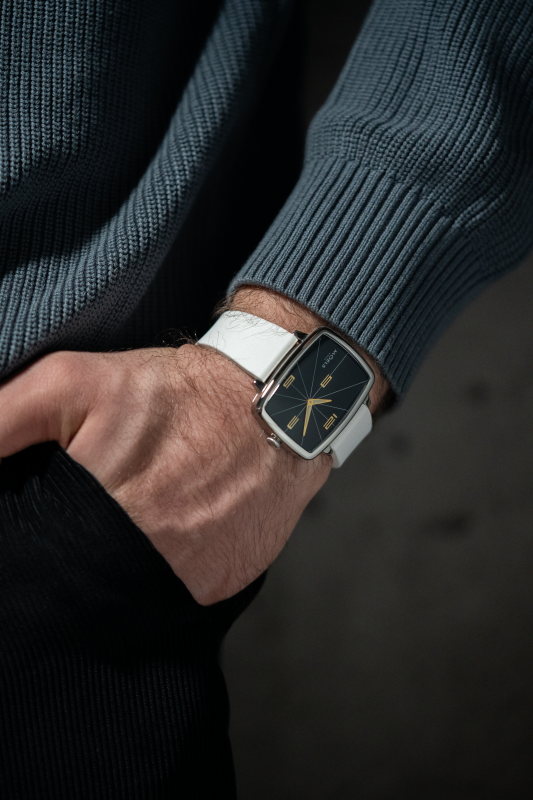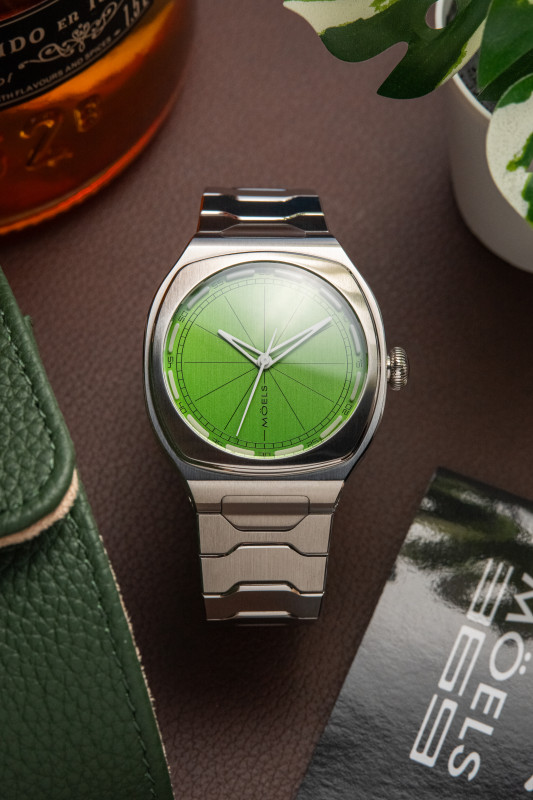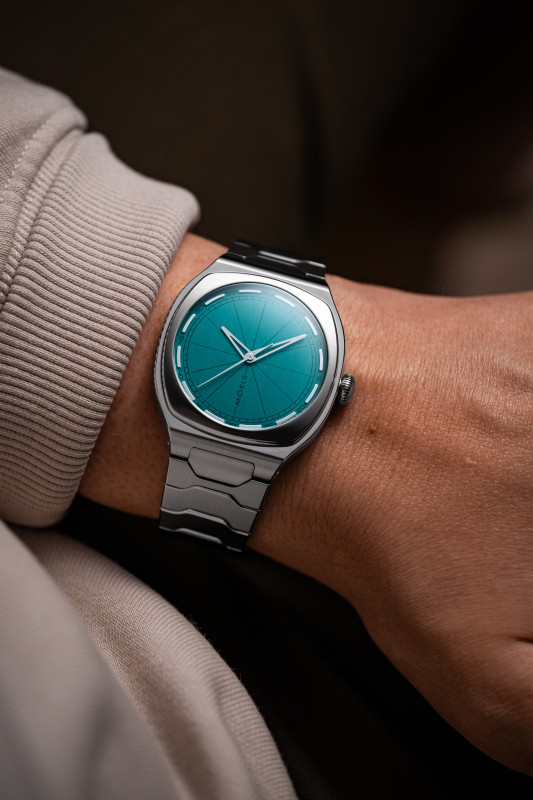


Betina Menescal is the founder and Creative Director of Möels&Co, an independent British watch brand known for its architectural approach to watch design and commitment to originality. While studying architecture in London, she discovered her passion for watchmaking during the Covid-19 lockdowns, when she began digitally recreating watches from her father's vintage collection as a way to develop her CAD and design skills. What began as an academic exercise soon evolved into creating original watch concepts, eventually leading to the development of the Möels 528—the timepiece that launched the brand.
Drawing heavily from her architectural education, Betina approaches
watch design through the principles of proportion, geometry, balance, and
spatial harmony. Rather than viewing the case, dial, hands, and bracelet as
individual parts, she designs every element as part of a unified composition,
resulting in watches that are both visually distinctive and ergonomically
refined.
Founded in the United Kingdom, Möels&Co has quickly established
itself as one of the rising names in the independent watchmaking scene. The
brand's philosophy centers on creating design-led mechanical watches that
challenge conventional styling without sacrificing functionality or wearability.
Every collection is developed from an original concept instead of relying on
existing case designs or industry templates, giving each watch a unique
architectural identity.
The internationally recognized Möels 528 exemplifies this
philosophy. Designed with complete creative freedom, it features unconventional
geometry, carefully balanced proportions, and a strong visual identity that has
resonated with collectors worldwide. Building on this success, Möels&Co
continues to refine its collections through improved construction, premium
materials, and upgraded mechanical movements while remaining true to its
independent spirit.
Today, Betina Menescal continues to lead every aspect of the brand's creative direction, combining architectural thinking with contemporary watchmaking to produce distinctive timepieces that appeal to collectors seeking originality, thoughtful design, and authentic independent craftsmanship.
Can
you tell us about your journey into watchmaking and what inspired you to
establish Möels&Co?
My interest in watchmaking began with my father, who has always had
a small collection of vintage watches, particularly Russian and German pieces.
I later moved to London to study architecture, and during the Covid lockdowns I
found myself at home trying to learn CAD and digital drawing softwares.
At the time, I was still in my first year and did not yet have the knowledge to draw buildings properly, so my father suggested that I practise by recreating some of the watches from his collection. After drawing all of them on the computer, I began experimenting with my own ideas. I designed many different watches before the 528 gradually came to life. My family, and especially my father, then helped me turn the design into a real project and bring the first collection to market through Kickstarter.
How
has your background in architecture influenced your approach to watch design?
Architecture taught me to think about proportion, geometry, materials, volume and the relationship between individual elements. I do not see the case, dial, hands and bracelet as separate components. I consider how they interact from every angle and how the watch sits on the wrist. Even a small change in curvature, thickness or surface finishing can completely alter the character of a design.
What
first sparked your fascination with watches, and how has that passion evolved
over the years?
My fascination started with my father’s collection. Initially, I was most interested in the visual but as I began developing my own watches, I became increasingly interested in movements, manufacturing, tolerances, finishing and also meeting the unique people in the watch industry. Today, I appreciate both technical achievement and simple, well-proportioned design, particularly when a watch has a clear identity.
What
were some of the biggest challenges you faced when launching a watch brand at
such a young age?
The greatest challenge was establishing credibility without a
reputation, a large budget or years of industry experience. I had to convince
manufacturers, suppliers and collectors to believe in an unfamiliar designer
and product.
I was also learning how to run a business while developing the watches. Beyond design, there are contracts, production, logistics, customs, quality control, marketing and customer service. Balancing originality with commercial viability was another important challenge.
Looking
back, what lessons from your early entrepreneurial journey continue to guide
you today?
The most important lesson has been patience. Watch development almost always takes longer than expected, and rushing decisions can create much larger problems later. I have also learned the importance of choosing reliable partners and communicating honestly with customers. My early Kickstarter experience taught me that a strong product also needs careful preparation, marketing and community building before launch.
What
is the core philosophy behind Möels&Co?
The philosophy of Möels&Co is to create original, design-led watches without relying too heavily on established formulas. Every watch should be recognisable, thoughtfully proportioned and enjoyable to wear, while offering something collectors have not already seen many times before.
How
would you describe the identity and personality of the brand?
Möels&Co is architectural, expressive and unconventionally modern. The watches have a confident identity, but they are not intended to be loud simply for attention. There is also a playful side to the brand, particularly in our use of colour, geometry and unexpected details. I would describe the personality as independent and optimistic.
In
today’s highly competitive market, what distinguishes Möels & Co. from
other independent watchmakers?
We begin with a design concept rather than an existing case or
catalogue product. The cases, dials, hands and visible elements are developed
specifically for each collection, allowing the watches to have their own
architecture. I am also comfortable working with less familiar shapes and
proportions. That originality is supported by experienced production partners,
respected mechanical movements and a direct relationship between the brand and
its collectors.
How
important is originality in watch design, and how do you ensure your creations
remain distinctive and authentic?
Originality is fundamental to me but as we all know every designer is influenced by architecture, art, history and the objects around them. Authenticity comes from transforming those influences into something personal rather than reproducing an existing watch. I begin with drawings, proportions and ideas, and then develop the case, dial, hands and straps as one connected design.
The
Möels 528 has received considerable attention. What inspired this model, and
what makes it special?
When I designed the 528, I was still very new to the watch industry.
I was not familiar with many brands, nor did I know which styles, shapes or
complications were considered the most commercially successful. I think this
lack of market knowledge gave me a great deal of creative freedom. I was not
designing according to what I thought would sell or trying to fit the watch
into an established category. I was simply experimenting with geometry,
proportions and different ways of arranging the dial until the design gradually
became the 528. It was not inspired by one specific watch, but by the process
of exploring form and trying to create something I had not seen before. I
believe that freedom is what makes the 528 special and why people continue to
respond to it as something genuinely distinctive.
What
innovations, design elements, or technical details are you most proud of
introducing through Möels&Co?
I am most proud of building a recognisable design language across fully customised components. Innovation does not always require a new complication, it can come from reconsidering how familiar elements are shaped and combined.
Do
you believe today’s collectors are increasingly seeking unique, design-driven
watches rather than traditional luxury brands? Why?
Yes, although I do not think independent watches replace traditional
luxury brands completely. Heritage and continuity will always remain important.
But, collectors now have much bigger access to smaller brands through publications, social media and enthusiast communities. Many are looking for watches that feel more personal, less predictable and produced in smaller quantities. They are also increasingly confident in choosing a watch because they genuinely connect with its design.
How
important is storytelling in building and growing an independent watch brand?
Storytelling is very important for an independent brand without a
century of history. People want to understand who created the watch, why it
exists and what the design represents.
However, the product must come first. A strong story cannot
compensate for a watch without substance or identity. The story should give
additional context to a product that is already compelling on its own.
Which
markets or regions have shown the strongest response to Möels&Co so far?
The United States has been our strongest market by a significant
margin. American collectors have been particularly receptive to independent
brands and unconventional design.
The United Kingdom is also important because the company was established there. We have also received strong support from collectors across Europe, Switzerland, the UAE and Australia.
How
do you envision the brand evolving over the next five years?
I want to expand the collection gradually, explore new constructions, materials and dial techniques, and continue improving the quality of every component. I would also like to strengthen our entry level offerings and create more opportunities for collectors to experience the watches in person.
What
watches do you personally enjoy wearing, and why?
Most of the time, I wear Möels&Co watches and prototypes.
Wearing prototypes is an important part of the design process because it
reveals details that drawings and renderings cannot.
At the moment, the 528 Series 2 is the watch I find myself wearing most often. Beyond my own brand, I hope to build a collection of watches from as many microbrands and independent watchmakers as possible. Some of the brands I particularly admire include Ming, Ikepod and MB&F.
What
can collectors and enthusiasts expect from Möels & Co. in the near future?
Our immediate focus is the relaunch of the 369 Series 2 and
introducing collectors to the improvements made to this generation, including
its slimmer construction, revised proportions and upgraded movement.
Alongside the continued development of our
main collections, we also plan to introduce a more accessible entry-level line.
This will allow a wider audience to experience the design philosophy of
Möels&Co, while our core collections continue to evolve through more
refined materials, movements and manufacturing techniques. The two lines will
serve different collectors, but both will remain distinctly Möels&Co in
their design and character.