

Ignacio T.
Justiniani
Founder, Justiniani Watches
Watches
have been a lifelong passion for you. Could you share the moment or experience
that first sparked this fascination?
My passion for watches sparked when I was a child, around 8 or 9 years old. I remember watching a James Bond film starring Pierce Brosnan, where the watch played a central, pivotal role at certain moments. That film was the catalyst. As the years went by, that initial fascination deepened. I became an explorer of horology, reading everything I could about the industry, its history, and its most representative models. It was an interest that methodically grew into a lifelong passion.
Unlike
many watchmakers, you come from an academic background, holding two master’s
degrees and a Ph.D. How has your scholarly work influenced your approach to
watchmaking?
My academic life—a constant immersion in writing, teaching, and history—instilled in me an enormous respect for the narratives, legends, and myths that define our civilization. This background is the lens through which I see the world; it allows me to value the power of symbols and our shared legacy. I firmly believe the pursuit of knowledge makes us better citizens. Therefore, building a brand dedicated to that pursuit, particularly through an instrument that measures time, felt less like an idea and more like an obligation
Justiniani
Watches draw inspiration from history and knowledge rather than racing,
aviation, or diving. Could you elaborate on how historical narratives shape
your designs?
Humans are, at their core, storytellers. We use narrative
to preserve the knowledge of the past for future generations. An instrument
designed to measure time should, in turn, pay tribute to this uniquely human
characteristic. Our designs are a tribute to the legends, heroes, and stories
that have shaped our present.
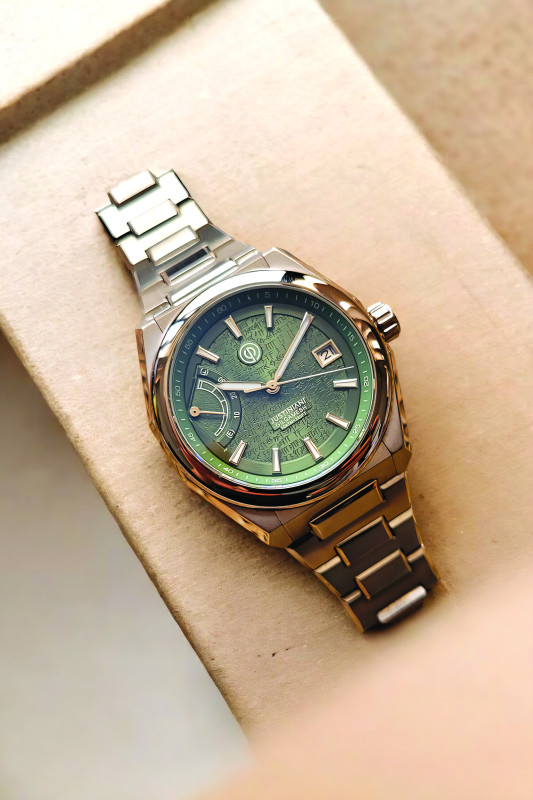
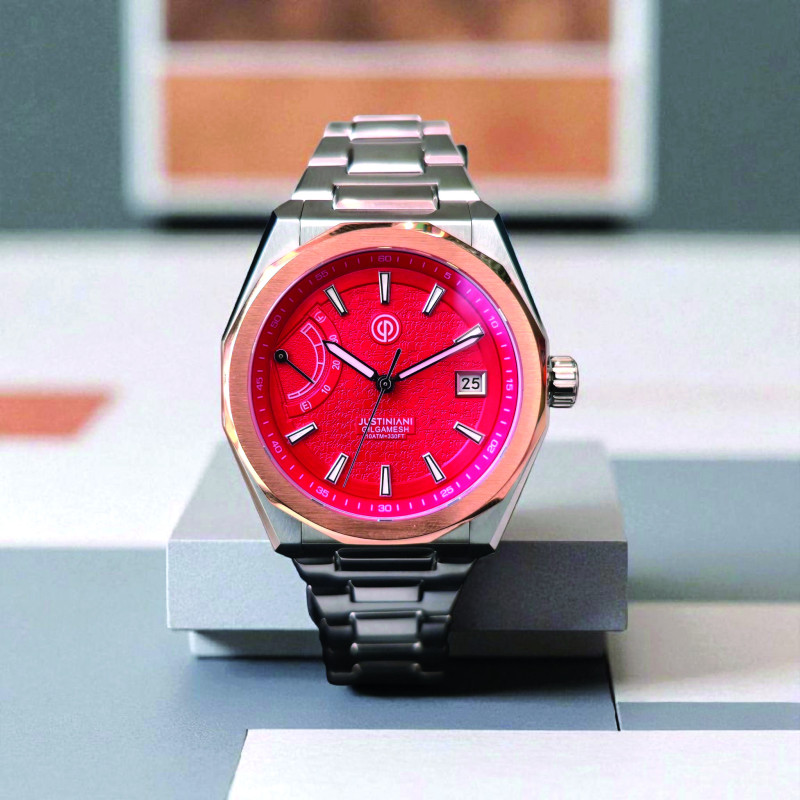
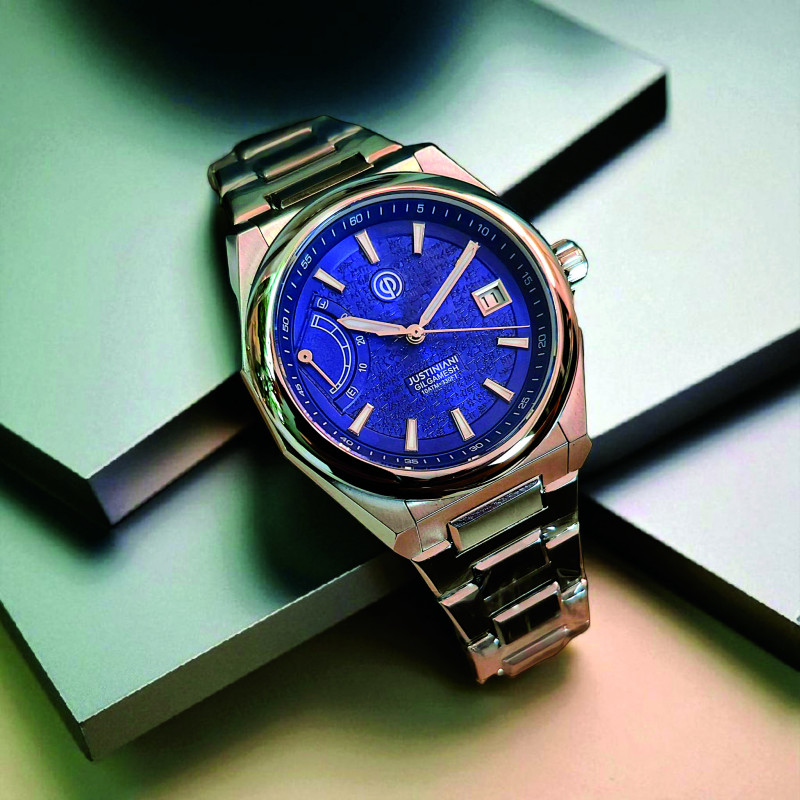
For example, our Gilgamesh watch is engraved on its dial and rotor with a fragment from the oldest story ever told: the Epic of Gilgamesh. Specifically, Tablet XI, the 'Flood Tablet.' It’s a story about mortality, the value of the present, and the human condition. Fusing this beautiful cuneiform writing with a contemporary precision instrument creates an irresistible blend of myth, time, and mechanical beauty
You
emphasize creating watches that are both mechanical and soulful. What do you
feel mechanical timepieces offer today that digital watches cannot?
Mechanical watches represent the very essence of time.
Unlike a digital device, a mechanical watch possesses a 'heartbeat.' It retains
the beautiful complexity of measuring time through an intricate harmony of
gears and springs, all working in concert. This mechanical soul is what
elevates it from a mere instrument to a miniature work of art a jewel that
reminds us of the passage of time and the transience of life.
Ancient cultures marked time with incense or the sound of falling sand. Mechanical watches keep that same tangible, living heritage alive on our wrist. A digital screen can display time, but it cannot embody it
The
Justiniani logo represents the golden ratio (φ) and references the Greek sculptor Phidias. How does this pursuit
of perfection and beauty influence the design of your watches?
The golden ratio, our logo, is a constant reminder of our commitment to classical harmony and aesthetic precision. It’s not just a mark; it is our design philosophy. While our inspiration comes from history and myth, our execution is guided by this pursuit of beauty. It means every design choice—from the case proportions to the layout of the dial—is scrutinized for balance, elegance, and timelessness. We are telling powerful stories, but we must do so in a way that is sober and sophisticated, never falling into caricature. The golden ratio is our standard for achieving that.
Are
there specific historical figures, events, or legends that have directly
inspired any of your watch collections?
Absolutely. Our first prototype was inspired by Odysseus.
The caseback features an engraving of him tied to the mast, navigating the
Sirens. This image represents the courage required to seek knowledge—to face
the unknown, hear the song, and be the first to return. That quest for what no
one has achieved before is what drives our brand.
Our first official release, however, was the Gilgamesh. As the first recorded hero in history, his epic speaks to the foundational human questions: the search for meaning, love, friendship, mortality, and the importance of living in the present. It was essential for our debut watch to carry the first story ever told.
Do
you personally get involved in the technical aspects of the watches, or do you
primarily focus on conceptual and design direction?
I am involved in the entire process, primarily setting the conceptual and design direction. My role is to ensure the narrative is seamlessly integrated into the timepiece. However, I have immense respect for technical expertise. I rely heavily on our watchmakers to determine feasibility and on external scholars to ensure historical accuracy. For the Gilgamesh watch, for instance, we collaborated closely with an expert in Assyriological studies and cuneiform to perfect the design. My vision is realized through their specialized knowledge.
Justiniani
watches aim to be “unforgettable.” Are there particular materials, techniques,
or innovations you use to achieve that sense of distinction?
What makes our timepieces distinct is their scholastic authenticity. For the Gilgamesh watch, we achieved the beautiful engraving on the dial and rotor by collaborating directly with a Sumerian language expert. This wasn't a computer font; the cuneiform symbols were meticulously rendered by hand, referencing the original clay tablets. This process makes the watch unique. Furthermore, we engraved a Lamassu on the rotor a mythological protective genius. In ancient Mesopotamia, these figures guarded temples and palaces. By including this symbol, the watch becomes more than a beautiful object; it becomes a personal talisman, just as the ancient Sumerians believed it would be."
How
do you see Justiniani Watches positioned in today’s luxury watch market,
especially compared to brands inspired by racing, aviation, or diving?
We are a nascent brand, but we occupy a very distinct and intentional position. The market is saturated with excellent watches inspired by physical pursuits—racing, aviation, diving. Justiniani Watches is inspired by intellectual and cultural pursuits. We are creating a new category for the individual who values history, philosophy, and legacy as much as performance. We don't just sell a tool; we offer a connection to the great stories of humanity. We are filling a void in the market for timepieces with genuine narrative depth.
You’ve
said the journey is “just beginning.” What are the next steps or upcoming
projects for the brand that collectors and enthusiasts should look forward to?
On our website, there is a timeline, much like a
Renaissance map, with known history filled in and blank spaces marked by
question marks. We left those spaces deliberately. Our future watches will
explore those 'uncharted' territories of human history. We are currently deep
in development on our next piece. I cannot reveal the details, but I will say
this: we have decided to go to hell and back to achieve the best possible
design.
How
do you want owners of Justiniani Watches to feel or connect with their
timepieces, both emotionally and intellectually?
Our watches are for those who value the power of symbols and the teachings of history. An owner of a Justiniani watch connects with it on both an intellectual and emotional level. We live in a world that is hyper-connected digitally, yet people often feel increasingly disconnected from each other and from their past. We want our timepieces to serve as a tangible link to our shared human legacy. They are symbols that recall the roots of our history and remind us that we are all part of a much larger story.
Watches
often carry stories and memories. What kind of legacy do you hope Justiniani
Watches will leave in the world of horology?
My goal is for Justiniani to be recognized as the brand that successfully translated the great narratives of human history into the art of horology. I want our timepieces to spark curiosity and conversation, perhaps reintroducing younger generations to the myths and legends that define us. The ultimate legacy would be for our watches to be seen not just as instruments, but as wearable symbols of our collective history.
For
aspiring watchmakers or enthusiasts who wish to combine personal passion with
professional expertise, what advice would you give?
My academic background conditioned me to follow rules, not
take too many risks, and often favor rigorous analysis over creative impulse.
For a long time, building my own watch brand seemed like an impossible dream.
However, over time, I understood that those limitations were self-imposed; they
were ideas I had chosen to believe rather than question.
So, my advice to anyone wishing to
merge passion with profession is simply to begin. Follow that passion,
interrogate your own limitations, and try. The only true mistake is not trying
at all.